

Introduction to Drone Technology
What is a Drone?
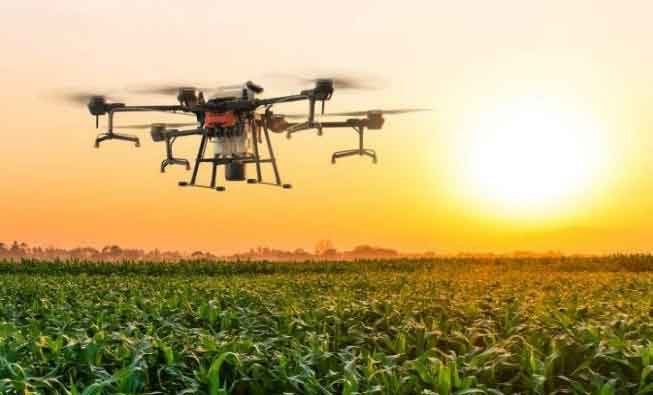
A drone, also known as an Unmanned Aerial Vehicle (UAV), is an aircraft that can fly without a human pilot onboard. It is controlled either remotely by an operator or automatically using GPS-based navigation. Agricultural drones are specially designed to perform farming activities such as spraying, monitoring, and mapping fields.
Types of Drones Used in Agriculture
- Multirotor Drones – Most common for farming; used for spraying, monitoring, and small-area mapping.
- Fixed-Wing Drones – Fly like airplanes; ideal for large-scale field mapping.
- Hybrid (VTOL) Drones – Combine both multirotor and fixed-wing benefits; take off vertically and cover long distances.
Each type is selected based on field size, crop type, and required operation.
Basics of Flight Principles
Drones fly using the principles of:
- Lift – Generated by propellers to help the drone rise.
- Thrust – Moves the drone forward.
- Weight – Pulls the drone downward due to gravity.
- Drag – Air resistance during flight.
The flight controller continuously balances these forces to keep the drone stable and controlled.
Applications: Spraying, Monitoring, Mapping
- Spraying: Drones spray pesticides, fertilizers, and nutrients uniformly across crops, reducing time and chemical usage.
- Monitoring: Using cameras and sensors, drones capture crop images to detect plant health, pests, water needs, and growth patterns.
- Mapping: High-quality aerial photos are stitched to create farm maps for planning irrigation, fertilizer use, and damage assessment.
Advantages of Drones in Modern Farming
- Saves time and labor by covering large fields quickly.
- Reduces chemical exposure for farmers.
- Uses less water and spray material, improving efficiency.
- Improves crop health through precise monitoring.
- Works in tough terrains where manual work is difficult.
